
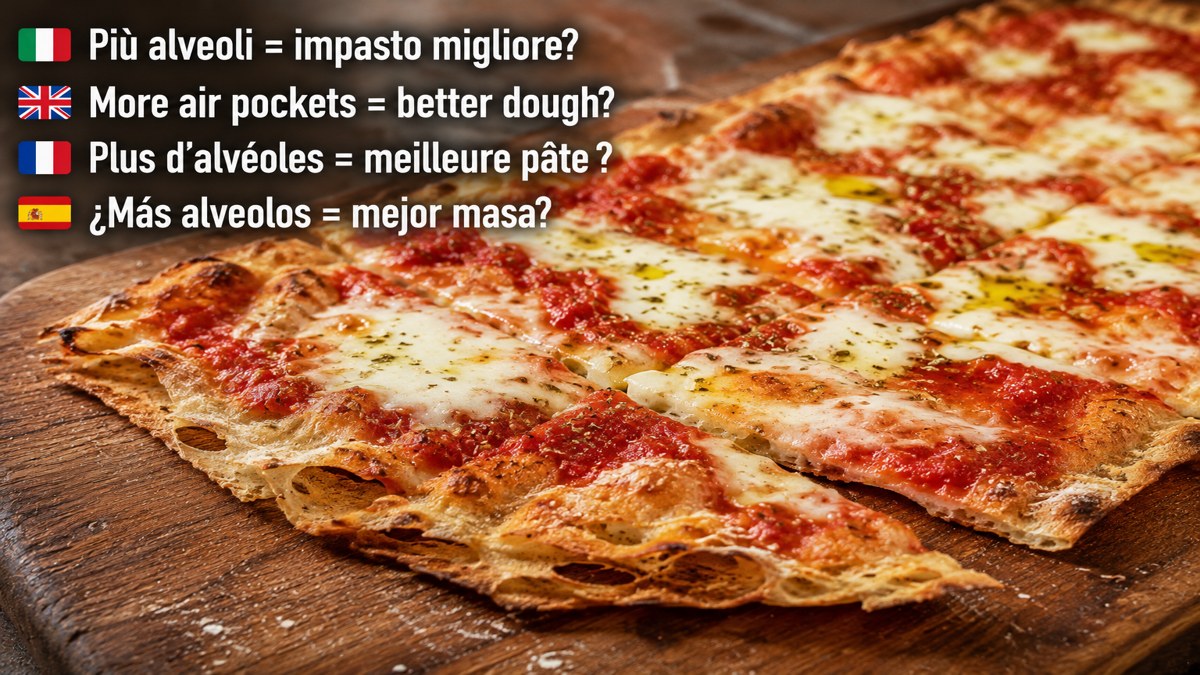
Do more air pockets mean better dough?
Not necessarily. Crumb structure has to be judged in relation to the pizza style we want: some styles deliberately seek a very open crumb, while others are meant to be thin, crisp or more regular inside.
Air pockets are not a score
A very open crumb can show that dough retained and expanded gas effectively, but hole size is not a universal measure of quality. Structure, baking, texture and consistency with the intended style matter more.
When an open crumb is desirable
Contemporary Neapolitan or canotto, many high-hydration tray pizzas and Roman pizza alla pala may deliberately seek a very open, irregular crumb. In these styles visible air pockets can be part of the target, provided the crumb is properly developed and baked.
When large holes are not the goal
Roman tonda or scrocchiarella is about thinness and crispness, not huge cavities. New York style, Chicago thin crust and tavern style also seek different structures; pan or pan-baked styles can have a finer, more regular crumb. They are not worse pizzas: they are designed for another result.
What creates crumb structure?
Flour and dough strength, hydration, gluten development, fermentation, shaping, stretching and baking all interact. Handling also determines how much accumulated gas we preserve, redistribute or expel.
More water is not enough
Higher hydration can encourage certain structures, but it does not guarantee larger holes or better pizza. Without suitable structure, fermentation and baking, extra water may simply make the dough harder to manage or the crumb harder to bake through.
Do not judge only from a photo
A huge cross-section can look spectacular, but a large cavity does not compensate for a wet, gummy or underbaked crumb. A thin crisp scrocchiarella with almost no large holes can be every bit as successful.
The Pizzood point
Do not chase the biggest hole. Look for the crumb structure that suits the pizza you want to make. Air pockets tell part of the story of dough management; they are not the final score.