
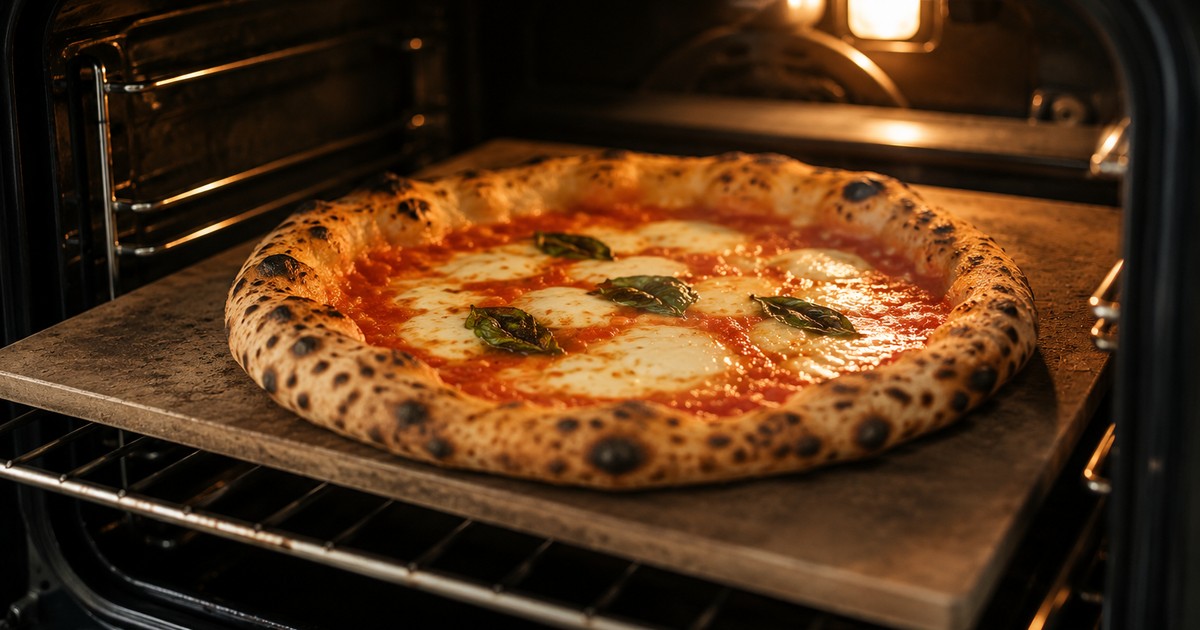
How can you make Neapolitan pizza in a home oven?
If your home oven reaches 250–300°C, it cannot behave like a pizza oven at 450°C. But that is no reason to give up. The useful approach is to understand the heat we actually have and adapt the dough and bake to our own oven.
Start with the oven you have
At home the bake inevitably takes longer, so blindly copying times and temperatures designed for a professional pizza oven rarely helps. We want enough energy at the base and crust without drying the pizza out. Every oven behaves differently; learning yours is more useful than copying a single number.
Stone or steel: give the base some help
A normal oven tray often stores and transfers too little energy. A thoroughly preheated stone can improve the bake considerably; steel transfers heat even faster and can be very effective in lower-powered ovens. Steel is not automatically better, though: if the bottom browns before the top, we have simply shifted the heat balance too far downward.
Preheat for real, not just until the beep
When the display says the oven is ready, the stone or steel may still need time to store enough energy. Give the surface time. If you have an IR thermometer, measure it directly. It is the same thermal-inertia principle that explains why an overheated stone can keep burning pizza even after you turn the oven down.
Move the pizza closer to top heat
In many home ovens it helps to place the stone or steel high in the cavity, reasonably close to the upper element. The broiler can be a great ally near the end: while the hot surface cooks the base, strong radiant heat helps the crust and toppings. Keep watching, because a few seconds under a powerful broiler can make a big difference.
Adapt the dough and toppings too
A dough designed to bake in about a minute is not necessarily ideal when it spends several minutes in the oven. Hydration, fermentation, extensibility, tenacity and flour characteristics all need to make sense for the bake. Toppings matter too: very wet mozzarella, too much tomato or too many ingredients make the balance harder. Drain wet ingredients well and avoid overloading the disc.
When the oven is not enough: the old pan + oven trick
During the Covid period this method found its way into kitchens everywhere. And really, who did not try it at least once? It is more than a fashionable trick. A very hot pan delivers strong conductive heat to the base; the broiler then finishes the top with radiant heat. We are separating two jobs that a modest home oven struggles to do at the same time.
How to use the pan + oven method
Heat a pan suitable for high temperatures, gently place the stretched disc in it and add toppings without overdoing them. Let the base begin to set and colour, then move the pizza high in the oven under the broiler to finish the crust and toppings. Do not treat two or three minutes as a rule: pans, burners, dough thickness and broilers vary too much. Watch the base, the crust and how the pizza responds.
The Pizzood rule
A standard home oven will not exactly reproduce a 60–90 second Neapolitan bake, and that is fine. It can still make an excellent Neapolitan-style pizza: soft, well developed and properly cooked underneath. The best pizza is not the one baked at the highest temperature; it is the one where dough, baking surface and oven work well together.