
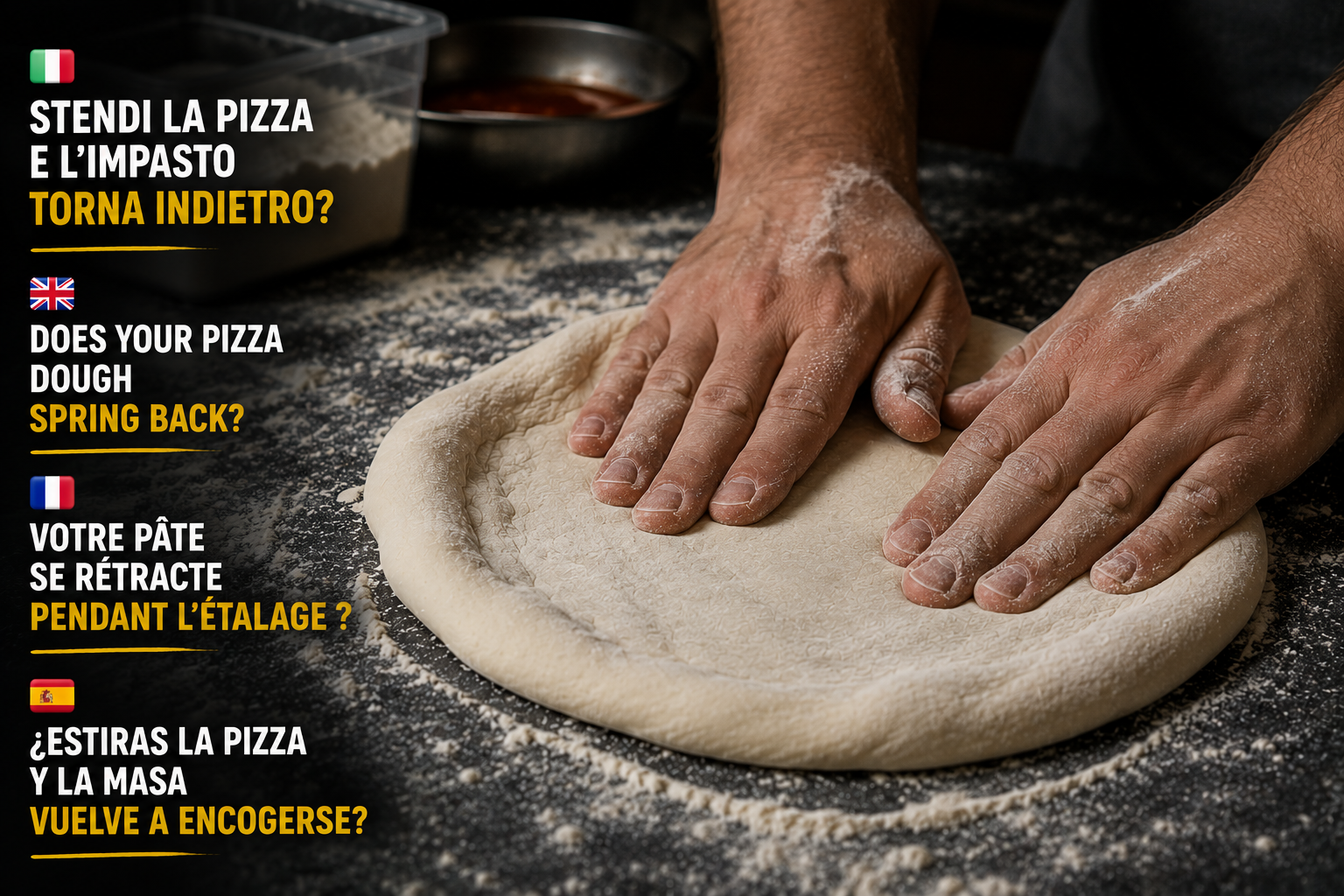
Does your pizza dough spring back when you stretch it?
When you open a dough ball and the disc shrinks back, you are seeing the mechanical response of the gluten network. Understanding tension, elasticity and extensibility helps you correct the cause without forcing the dough.
What is happening inside the dough
Stretching deforms the gluten network. When elasticity dominates extensibility, the structure tends to recover part of its previous shape and the disc contracts. The gluten network is still under relatively high tension and resists elongation. This does not automatically mean the dough is wrong; it means its rheological balance is not ideal for the stretching you want to perform at that moment.
The most common causes
A final proof that is too short can leave the dough ball under considerable tension after dividing and shaping. Low temperature can also increase the sensation of tenacity: a cold dough ball is often less willing to deform. Flour characteristics, especially the balance between tenacity and extensibility, mixing intensity, folds and the tension created during balling also matter. Each can shift the dough toward greater elasticity.
What to do when the disc shrinks back
First, do not fight the dough: applying more force does not remove tension and can create thin spots or tears.
1. Check the temperature. If the dough ball is still cold from refrigeration, let it warm toward a suitable working temperature. Its mechanical response changes as temperature rises. There is no universal number of minutes: dough temperature, room temperature, ball size and flour all matter.
2. Give it time to relax. If the temperature is suitable but the dough remains very tenacious, extra rest can reduce tension in the gluten network and increase extensibility, especially after tight balling.
3. Stop instead of forcing it. If the disc keeps springing back, pause, let it relax and try again. Pulling harder does not correct the cause.
4. If it happens often, review balling. Tight balling creates surface tension. That can be useful, but tighter is not automatically better: balling tension and final proof must work together.
5. Review the final proof. A very tenacious dough ball can indicate a final proof that is too short for the flour, temperature and process. This does not mean always adding more hours: highly fermented dough should not be corrected by extending time indiscriminately.
6. Look at flour and mixing. If the problem repeats despite suitable time and temperature, consider the flour’s rheological characteristics and how strongly the gluten network was developed. The answer is not automatically a weaker flour, but a better match between flour, mixing and the result you want.
Watch for the opposite problem
Good dough should not have zero elasticity. If a dough ball spreads almost by itself, cannot hold its shape and quickly loses structure, you may be seeing the opposite extreme: insufficient tension, weakened structure or excessive relaxation. Elasticity and extensibility are not enemies; they must coexist in the balance required by the pizza you want to make.
The Pizzood rule
We are not looking for dough with no resistance. We want controlled tension and a balance between elasticity and extensibility that lets us open the disc without fighting it and without losing structure. Stretching is therefore also a test: it shows how flour, mixing, temperature, fermentation, dividing, balling and final proof have worked together.