
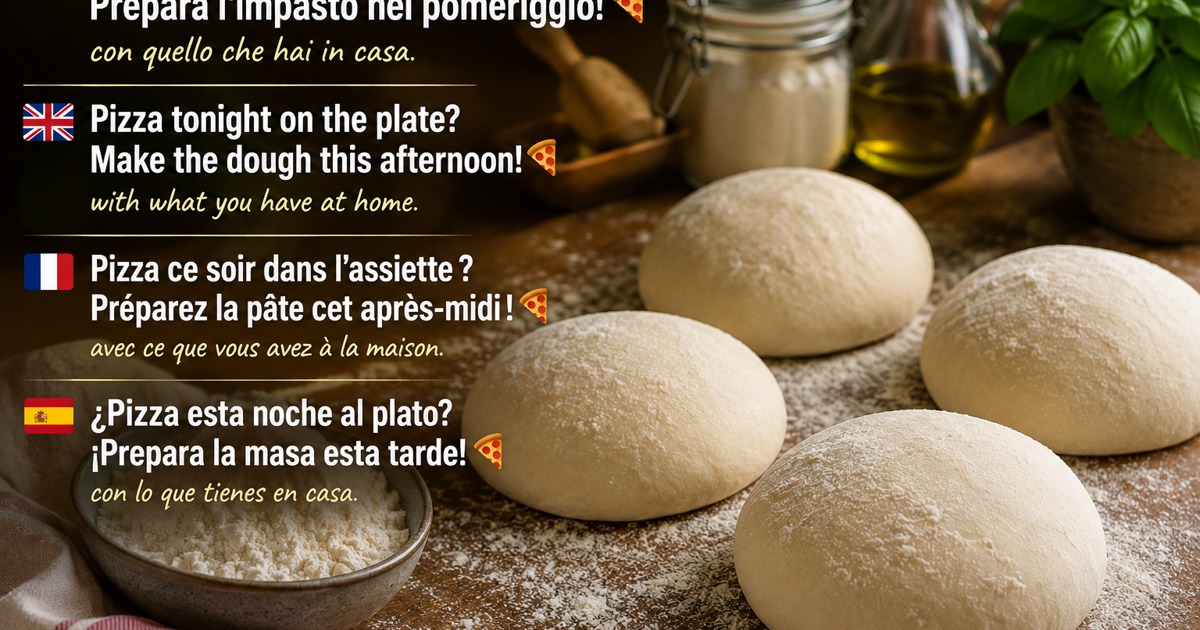
Pizza tonight? Make the dough this afternoon!
Decided this afternoon that you want a round pizza tonight? Your dough does not have to be started the day before. With ordinary ingredients, a little time and a simple process, you can make a good same-day dough entirely by hand.
A recipe for real life
This is not a promise of the “perfect pizza in four hours”. It is a practical base for those days when the pizza craving arrives in the afternoon. No mixer, hard-to-find flour or complicated routine: just a bowl, your hands and ingredients you can normally find at home.
Ingredients for about 4 pizzas
For roughly four 245–250 g dough balls, use 600 g flour, 360 g water (60% hydration), 18 g salt (3%) and about 3 g fresh baker’s yeast, or about 1 g dry yeast. Treat these as starting quantities: room temperature and the hours available may require adjusting the yeast in particular.
Which flour should you use?
An ordinary supermarket 00 pizza flour or similar medium-strength pizza flour works well. With only a few hours available, there is little reason to choose flour designed for very long fermentation. For a slightly more rustic flavour, try 70% white pizza flour and 30% less-refined flour. It is not automatically better; it simply changes flavour, handling and dough characteristics.
Hand kneading without making it difficult
Dissolve the yeast in the water, add most of the flour and mix. When most free water has been absorbed, add the salt and the remaining flour. Knead by hand for a few minutes; there is no need to fight the dough for half an hour. Rest it for 10–15 minutes, then return and make a few folds until it feels smoother, more elastic and organised. The rest is doing part of the work for you.
From afternoon to evening
Leave the dough covered for roughly 1–2 hours, then divide and ball it without creating unnecessary tension. Keep the dough balls covered until evening. They should grow, relax and become easy to stretch. Do not wait for a mathematically perfect doubling: look at the dough and how it responds to your touch.
Warm kitchen? Cool kitchen?
Three grams of yeast will not behave the same way at 19°C and 29°C. In a warm kitchen, reduce the yeast or bring the schedule forward; in a cool kitchen, allow more time or increase it slightly. Yeast is a tool for matching fermentation to the time you have, not a number to follow blindly.
In the evening: get the oven ready
Preheat your oven well and use its highest useful temperature. If you have a stone or steel, give it enough time to store heat; if not, a heavy baking tray preheated upside down can work as a simple baking surface. Stretch gently without unnecessarily crushing the rim and avoid overloading the pizza with very wet toppings, because a home-oven bake lasts longer.
The Pizzood rule
You do not always need 24, 48 or 72 hours. Longer fermentation and less yeast do not automatically make pizza better or more digestible. Sometimes you simply want pizza tonight. Common flour, 60% hydration, hand kneading and sensible fermentation management can get you there — and that is perfectly fine.