
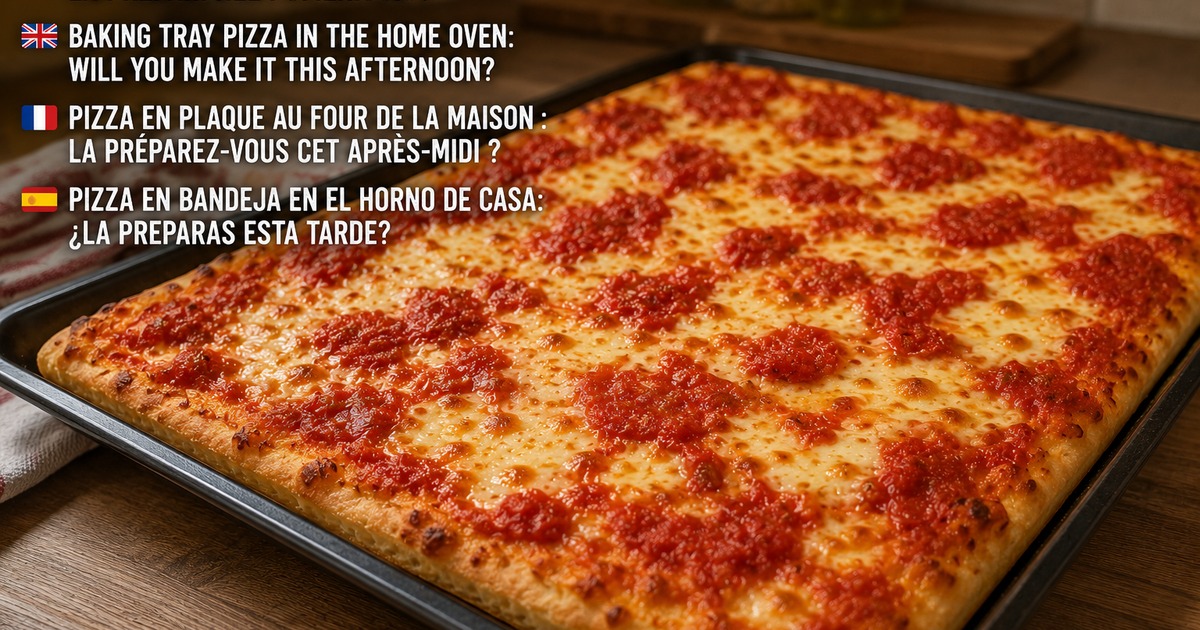
Tray pizza in a home oven: balance for the best result
You do not need to make everything complicated to get a very good tray pizza from a home oven. A manageable dough, the right tray and a two-stage bake can give you a soft interior, a properly cooked base and a pizza that is simply enjoyable to eat.
A dough designed for a home oven
We deliberately choose 62% hydration and 1.5% oil. We are not chasing the highest possible number: we want a balance between softness, easy handling and the ability of a domestic oven to bake and dry the dough properly.
Ingredients: a simple starting point
As a reference, start with 500 g flour, 310 g water (62%), 12.5–15 g salt (2.5–3%) and 7.5 g extra-virgin olive oil (1.5%). Adjust the yeast to the time available and room temperature: there is no single correct amount independent of time and temperature.
Which flour?
An ordinary medium-strength pizza flour from the supermarket is more than enough for this home process. If you enjoy a slightly more rustic flavour, you can add a small proportion of less-refined flour. There is no need for extremely strong flour unless your process actually requires it.
Why 62% hydration?
Because more water does not automatically mean better pizza. Higher hydration can give excellent results, but it also asks for more control over mixing, fermentation and baking. At 62% the dough is soft while remaining straightforward to handle and stretch, even when kneading by hand.
Why 1.5% oil?
In a home oven, where baking is longer than in a very hot pizza oven, a small amount of oil can help softness, texture and browning. It is a choice that supports the result we want, not a universal rule for every tray pizza.
Stretching: guide the dough into the tray
Lightly oil the tray and gently work the dough towards the edges without tearing or unnecessarily crushing it. If it keeps shrinking back, stop for a few minutes and let it relax before continuing. Forcing it usually makes stretching harder, not faster.
Bake the base first
In a domestic oven we need to distribute the available energy well. Start by baking the base without the full topping, preferably low in the oven. This lets the dough build structure and the bottom begin to bake without simultaneously dealing with all the moisture from tomato, mozzarella and other toppings.
Then top it and finish baking
Once the base has developed structure, take the tray out, add the toppings and return it to the oven. During this second stage you can move it higher if the top needs more energy. Do not become tied to an exact number of minutes: dough thickness, tray material and oven behaviour vary greatly. Watch the base, edges and surface.
Light tray, dark tray, steel or aluminium?
The tray is part of the baking system too. Material, thickness and finish change how quickly heat reaches the base. A dark or steel tray can be more aggressive than a light aluminium one. If the bottom colours too quickly, the dough is not necessarily the problem: tray and oven position must be considered together.
The Pizzood point
The best result in a home oven does not necessarily come from making the dough more complicated or chasing extreme hydration. It often comes when dough, tray and oven work together: 62% water, 1.5% oil and a two-stage bake are an excellent place to start.